

Most hosts plan holiday let changeover time by adding up how long each job takes and checking the total fits between checkout and check-in. On a same-day changeover the total matters less than the order: a wash that starts late, a bed that can't be made until the dryer finishes, or a fault found halfway through will push everything behind it past arrival time. This guide sets out how to order the work, which jobs decide when you finish, and what to do when the day doesn't go to plan.
Why the order matters more than the total
A same-day changeover has a fixed start and a fixed finish. You can't begin until the last guests have gone, and the next guests expect the property ready when they arrive. Everything in between has to fit, and some of it can't move.
Most jobs can happen in any order. Wiping down the kitchen, vacuuming the stairs and restocking the bathroom can be shuffled to suit whoever is working. A few jobs are tied to each other: the beds can't be made until there is clean linen, the floors can't be mopped until the furniture is back, and the final walk round can't happen until everything else is done. Those links decide when you finish.
If one of the linked jobs slips, every job that depends on it slips too. If an independent job slips, you can usually absorb it by doing something else in the meantime. Knowing which is which is what lets you protect the finish time when the day starts late.
A same-day changeover in stages
Breaking the day into stages makes the linked jobs visible. The table shows a typical order for a self-catering property with a washing machine on site. Your own jobs will differ, but the stages and the questions in each column usually hold.
| Stage | What happens | Can it move? | If it runs late |
|---|---|---|---|
| Arrival checks | Walk round for damage, faults, lost property and anything left switched on | No, it decides the rest of the day | Report anything urgent before starting the cleaning |
| Strip and start the wash | Strip every bed and towel, load the machine and start the first cycle | No, the wash has to start early | Put clean sets on the beds rather than waiting for the wash |
| Kitchen and bathrooms | Clean while the machine runs | Yes, these fit around the machines | Do the bathrooms first, because guests tend to notice them first |
| Beds and soft furnishings | Make up every bed, set out towels | Only if clean linen is ready | Use a spare set from the cupboard |
| Floors and living areas | Vacuum, mop, put furniture back | Yes, but mop last | Skip the less used rooms and note them for next time |
| Restock and final walk round | Consumables, heating, lights, photos, the all-clear | No, it has to come last | Shorten it, but never skip the safety checks |
The holiday let changeover planner lets you try your own times against this order before the next booking, and the stages explain why it treats some jobs differently from others.
Checking the property before cleaning starts
The first few minutes after checkout decide how the rest of the day goes. Before stripping a single bed, walk through every room and look for anything that changes the plan: a broken appliance, a stain that needs treatment, something missing, a window left open on the rain, or a heater that has been on all night.
Finding a problem now gives you hours to deal with it. Finding the same problem while making the last bed leaves you minutes. A cracked shower screen spotted at the start can be reported to a repairer, photographed for a damage claim and worked around. The same crack found at the end can mean ringing the arriving guests.
Photograph anything you find before you touch it. The photos are your record for the departing guest, for the platform if you make a claim, and for whoever fixes it. Keep the walk round short and fixed so it's done the same way every time. Building a changeover checklist from scratch for a new holiday let covers how to turn your property's weak points into the checks that go first.
Laundry is usually the job that sets the pace
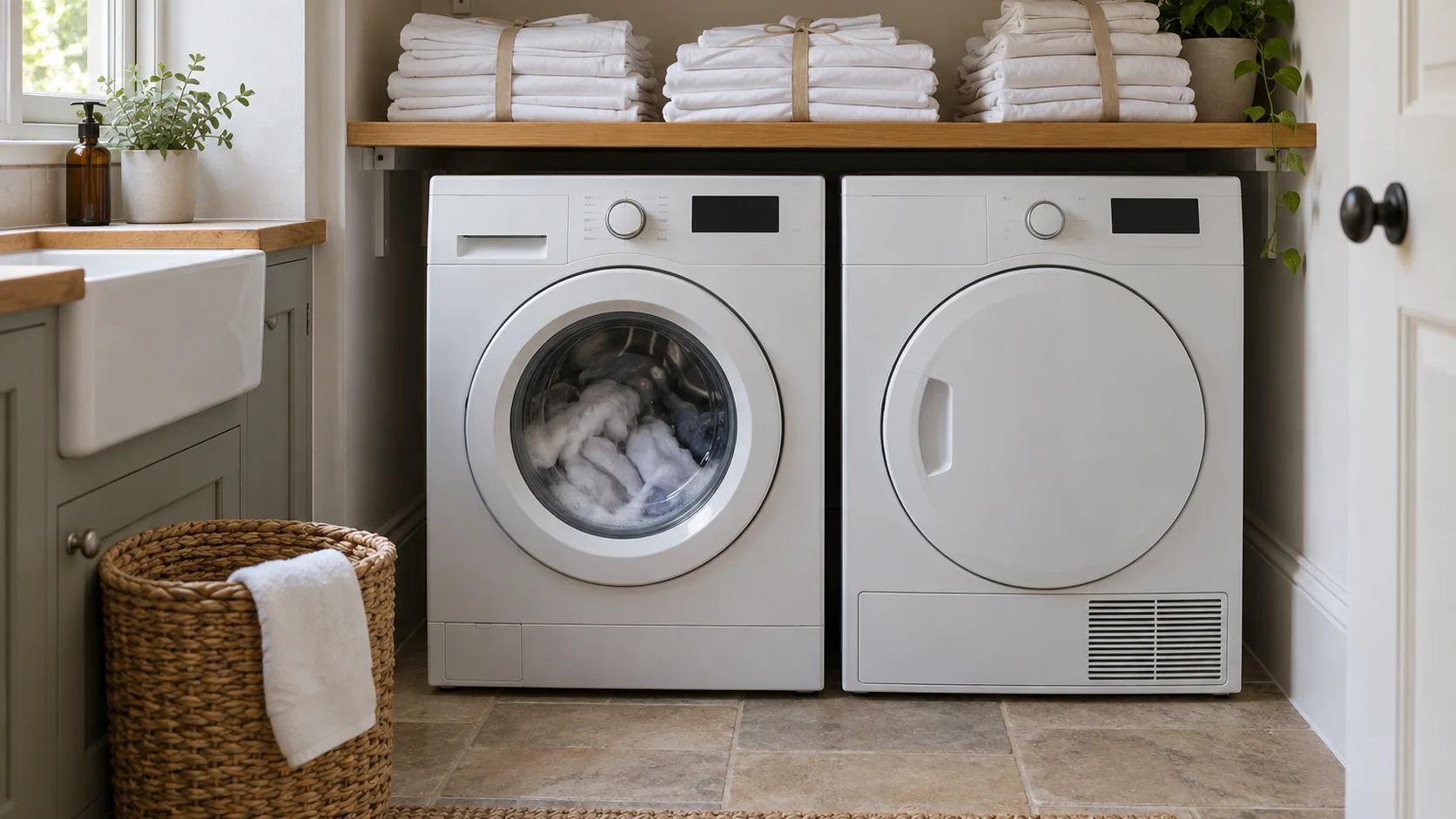
On most same-day changeovers the washing machine decides the finish time. A full wash and dry often takes longer than any single cleaning job, and on a larger property one machine can't wash everything in the time available.
The way round it is to stop the beds waiting for the wash. Keep enough clean sets in the property that every bed can be made from the cupboard as soon as it is stripped. The dirty linen can then be washed during the day, after the next guests arrive, or collected for laundering elsewhere. The beds stop depending on the machine, and the machine stops deciding the finish time. Holiday let linen: hire or buy, and how many sets to keep for each bed works out how many sets that takes.
If you wash on site, start the first load as soon as the beds are stripped, because every minute the machine sits idle early on is a minute you can't get back later. Put towels and bedding in separate loads if they need different temperatures, and keep a note of how long each cycle takes on your own machine rather than relying on the dial.
If you use a laundry service, find out when it collects and delivers, and what happens on a bank holiday. A delivery that arrives after the next guests is no help on a same-day changeover.
Jobs to move off the same-day list
A changeover that fits on a quiet weekday can fail on a busy Saturday because the list has grown. Over time, jobs creep on that don't need doing at every changeover: descaling the kettle, cleaning the oven, washing cushion covers, wiping skirting boards.
Go through the list and ask of each job whether the next guests would notice if it waited a week. Anything they wouldn't notice belongs on a separate list for the longer gaps between bookings. Holiday let deep clean: a room-by-room checklist and when to do it covers which jobs to move there and how often to do them.
Keep the safety checks on every changeover, however short the gap. Smoke and carbon monoxide alarms, the fire blanket, escape routes clear, the hot water working and the door locking properly all stay on the same-day list. They take minutes, and they're the checks you'd least want to have skipped if something went wrong.
Hot water and heating need their own time
Two jobs on a same-day changeover don't depend on how fast anyone works: reheating the hot water and warming the property. Both run on their own clock, and both are easy to forget until the guests notice.
Departing guests often shower just before they leave, and in a property with a hot water cylinder a full house can empty it. If you then run the washing machine and clean the bathrooms with hot water, the cylinder may still be recovering when the next guests arrive and want a shower after their journey. Find out how long your cylinder takes to reheat from cold, and if it's slow, set the water to heat as soon as you arrive rather than relying on the timer.
In cold weather the same applies to the heating. A property left with the heating low for the changeover can take a long time to feel warm again, especially an older stone cottage. Turn the heating up early enough for the rooms to be comfortable at check-in, not just for the radiators to be warm.
Put both on the plan as jobs with a start time, near the beginning of the day. They take seconds to set and can't be rushed at the end.
Guests who stay past checkout
A late checkout is the most common reason a same-day changeover runs short. Sometimes it's agreed in advance, sometimes the guests simply haven't left when the work is due to start.
If a guest asks for a late checkout on a day with arrivals, decide using the time you need, not the time you'd like. If the changeover only fits with the full gap, the answer is no, or yes for a shorter extension than they asked for. Offering a late checkout only on days with no same-day arrival keeps the request easy to answer.
If guests are still there when the work should start, start on what you can without disturbing them: an outside area, a bedroom they've already left, bins and recycling. A polite message saying you're outside and ready when they are usually moves things along. If they're still there long after checkout, it's reasonable to ask them to leave; the time is in the booking terms they agreed to.
Once they've gone, cut the day to the linked jobs first. Start the wash, strip and make up the beds from clean sets, then the bathrooms and kitchen. Leave anything that can wait until after arrival, such as outside tidying or a second load of towels.
Guests who want to arrive early
Early arrival requests land on the same day as late checkouts, often from the same kind of guest: someone with a long journey and a booking that starts later than they'd like.
On a same-day changeover, an early arrival takes time straight off the end of the work. If the property isn't ready, saying no is kinder than letting guests in while the floors are wet and the beds half made. Offer what's possible instead: somewhere to leave bags, a time you'll message when it's ready, or a nearby place to eat while they wait.
If the changeover finishes early, a short message saying the property is ready and they're welcome to arrive now is a better surprise than a promise you might not keep. The holiday let check-in message sequence that prevents most access problems covers where that message fits alongside the access details guests already have.
Problems found halfway through
Some problems only show up once the work has started: a blocked sink, a toilet that won't stop running, a stain that won't lift, a light that has gone. Decide quickly whether it has to be fixed before the guests arrive, or whether it can be fixed during their stay with their agreement.
Anything that affects safety, water, heating, hot water, a toilet or a door that locks has to be sorted or properly made safe before arrival. Anything cosmetic, such as a scuff, a missing coat hook or a light in a spare room, can usually wait, as long as you tell the guests and arrange when it will be done.
If a repair won't be finished in time, tell the arriving guests before they set off, not when they reach the door. Say what's affected, what you've done, and when it will be fixed. Most guests accept a clear message sent early far more easily than a surprise on arrival.
Keys and codes on a changeover day
A same-day changeover is the one time two sets of people need access to the property within a few hours. The departing guests' access has to end, the people doing the changeover need to get in, and the arriving guests' access has to start at the right moment.
If you use codes, set the departing guests' code to stop working soon after checkout and the arriving guests' code to start at check-in time. Whoever does the changeover needs their own code that works all day, so they're never waiting at the door or using a guest's code. If you use a key safe, check the key is back in the box at the start of the changeover, not at the end, when there's no time left to find it.
Before you leave, check the door locks properly from outside and the code or key safe works for the arriving guests. A changeover that finishes perfectly and then leaves guests unable to get in has still failed.
Two people, or more time
If the plan still doesn't fit after moving jobs off the list and taking the wash out of the timetable, the choice is more help or a longer gap between bookings.
Two people on a same-day changeover rarely halve the time, because some jobs can't be split and the final walk round still needs one person to see everything. They do take the pressure off the linked jobs: one person strips and makes beds while the other cleans the kitchen and bathrooms. If you bring in help for the busier days, both of you need to work from the same list in the same order. Coordinating a holiday let cleaner or co-host without duplicating your checklist covers how to keep one list you both work from.
The other option is time. A later check-in or an earlier checkout widens every same-day gap. Some hosts set a minimum stay on their busiest weeks, so fewer same-day changeovers fall in the period when getting help is hardest.
What ready means before the guests arrive
Decide in advance what has to be true before you send the all-clear, and keep it the same every time. It stops the end of a rushed changeover becoming a judgement call made while watching the clock.
A useful standard is short: every bed made, clean towels out, bathrooms and kitchen clean, bins emptied, the safety checks done, the heating and hot water on, and the door tested. Anything beyond that, such as a fresh welcome note or flowers, is a bonus on a same-day changeover, not a requirement.
Take a few photos of each room as you leave. They show what the property looked like at check-in, which helps if a guest later reports a problem, and they let you check the work if someone else did the changeover. Then send the arriving guests their access details, or the message saying the property is ready, at the time they expect it.
When to block a same-day turnaround
Some same-day changeovers aren't worth taking. A large group leaving a property that needs more than the gap allows, a booking on a day you can't be there and have no cover, or a changeover straight after a stay you expect to leave extra work can all end with guests arriving to an unfinished property.
You can block the night before or after a booking in your calendar, and some platforms also let you stop guests arriving on particular days. Use those settings for the changeovers you already know won't fit, rather than taking the booking and hoping. A night left empty costs one night's income. A poor review after a rushed changeover can cost more bookings than that.
Keep a short note of every same-day changeover that ran late and why. After a few months you'll see which days, groups or seasons cause the problems, and you can set your calendar rules from what happened rather than from guesses.
Timing your next same-day changeover
On your next same-day changeover, note the time you start and the time each stage finishes. Write down anything that held you up: a late checkout, a slow wash, a fault, a job that wasn't on the list.
Compare those times with your plan. Move any job that ran long, take anything that could wait off the same-day list, and decide whether the beds are still waiting for the washing machine. After two or three timed changeovers, your plan will reflect your property rather than a guess, and you'll know how much room you have before arrival.