
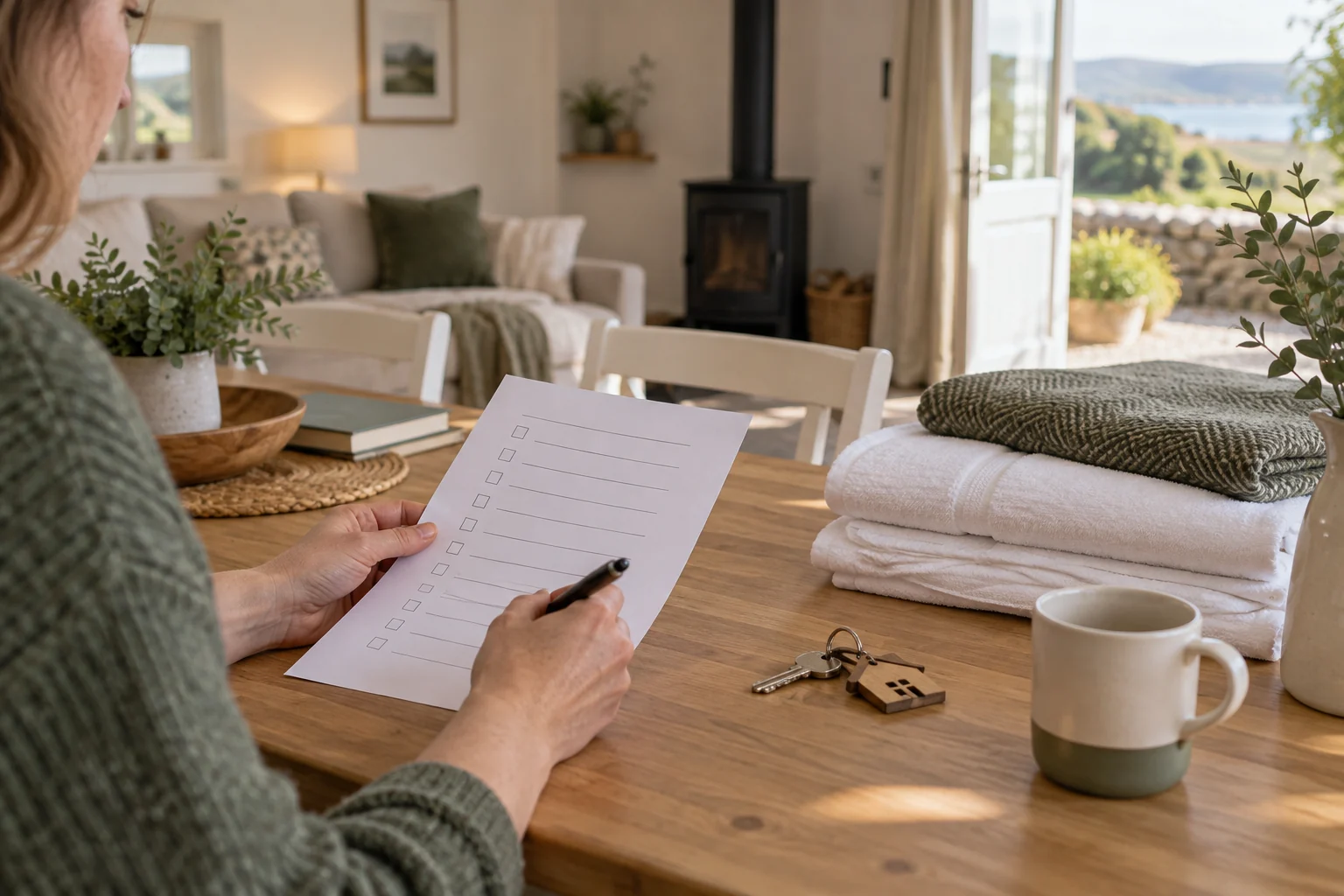
The most common mistake with a new holiday let is downloading a changeover checklist template and using it as it is. A checklist that works is a record of one property's failures, so someone else's template misses what will go wrong in yours. This guide shows you how to build your own from the property's weak points: a walkthrough as if you were a guest, a first draft sorted into what matters, and five real changeovers to test it before it settles.
Why changeover templates leave gaps
Search for a changeover checklist and you'll find dozens of near-identical lists: strip beds, wash linens, wipe surfaces, check for damage, restock toiletries, take photos. They're not wrong. They're just generic, and generic is the problem.
A generic checklist is built for an average property that doesn't exist. It won't mention the stiff sash window in your bedroom that guests always leave open, letting rain in on the sill. It won't mention that your walk-in shower has a lip guests trip on unless they're warned, and that the mat needs replacing after every third stay because of it. It won't mention your specific washing machine's tendency to leave a smell in the drum if the door's shut straight after a cycle.
Those are property-specific failure points. No template will ever contain them, because a template author has never stood in your kitchen.
The instinct when facing a blank checklist is to grab someone else's and adapt it. That produces a checklist that looks complete and reads well, but it's just a generic cleaning list wearing your property's name. It'll get you through the first few changeovers fine, because most changeovers don't test the gaps. Then a guest opens a cupboard you never open, or comments on the water pressure, or the extractor fan you've never looked at closely turns out to be caked in grease from the previous tenant's cooking habits.
None of this means you did anything wrong on changeover one. It means your checklist was built from the outside, describing what changeovers generally involve, rather than from the inside, describing what this changeover specifically requires.
Build the checklist from the property's weak points
A changeover checklist for a brand new property isn't a cleaning document at all, not at first. It's a map of where this specific property can let you down. The cleaning tasks come later, as consequences of the map.
Think of it like this: every property has a set of places where dirt, damage, wear or awkwardness accumulates faster than elsewhere, and a set of places where nothing much ever goes wrong. A refined checklist, the kind that seems effortless after fifty changeovers, is just a checklist that has learned to spend its attention on the first set and skip the second.
You don't have fifty changeovers of data. But you don't need fifty. You need one focused walkthrough done properly, plus a habit of capturing what you learn from the first several real changeovers so the checklist grows accurately instead of by guesswork.
Doing the stranger's walkthrough before you write a single line
Before you write anything, walk through the property as if you are a guest who has never seen it and who is mildly suspicious that it might be dirty or badly kept. Not as the owner who knows it's fine. As someone looking for reasons to complain.
Go room by room. In each room, open every door, drawer, and cupboard, run your hand along skirting boards and window sills, look under the bed, check behind the toilet, look up at light fittings and extractor fans, and press on mattress edges and sofa cushions.
Write down, in a notebook or a notes app, every single thing that could reasonably bother a paying guest. Not just visible dirt. Look for four kinds of problem.
Four things to look for on the walkthrough
Use these four headings for your notes in every room.
| What to look for | Examples | What it needs |
|---|---|---|
| Worn even when clean | A scuffed door, grout that won't come white | Replacement, camouflage, or a mention in your listing |
| Grime that builds fast | Extractor fans, showerhead limescale, the washing machine door seal, behind the fridge | A place on the every-changeover or periodic list |
| Things guests touch that owners forget | Remote controls, light switches, door handles, the underside of dining chairs | A line on the every-changeover list |
| Things that fail quietly | A wobbly table leg, a sticking drawer, a curtain rail coming away | The repair list, not the cleaning list |
This walkthrough should take a full hour or two for a typical property, not twenty minutes. Rushing it defeats the purpose, because the entire value of this exercise is catching the things a normal five-minute tidy would miss.
Turning the walkthrough into a checklist
Once you have your list of failure points, you need to sort them into three categories, because they don't all belong in the same place.
Sort every item into one of three lists
Keeping repairs off the cleaning list is what gets them fixed.
| List | What goes on it | Examples |
|---|---|---|
| Every changeover | Anything needed between every guest | Linen, surfaces, the shower lip, the sash window latch |
| Periodic | Needed on a rhythm, not every time | Descaling the showerhead, the extractor filter, dust under furniture |
| Repairs | Anything that needs fixing, not cleaning | The wobbly table leg, a sticking drawer |
Give the periodic list its own schedule, such as monthly or between seasons, so it doesn't clutter changeover day or get forgotten. Anything on the repair list that could affect a guest mid-stay is worth fixing first, because what to do when a holiday let guest reports a fault mid-stay is a harder conversation than a repair done in advance. Winter brings its own periodic jobs, and holiday let winter maintenance covers the autumn checks and the weekly visit during empty weeks.
Write your every-changeover list as a route through the property. Start at the entrance and move room by room in the order you would walk it, rather than grouping tasks by type. A list that follows the building stops you doubling back, and a missed room becomes obvious because the gap sits where the room should be.
Safety checks that go on every list
Some items belong on every changeover list whatever the property, because they protect guests rather than presentation: test the smoke and carbon monoxide alarms, check escape routes and exits are clear, and check the lock or key safe works, including smart lock batteries.
They take a couple of minutes and are easy to skip when you're behind. Put them first, so they're done before the rushed end of the changeover. Fire safety for holiday lets explains why the alarm and escape-route checks matter, and the check-in message sequence that prevents most access problems covers what a failed lock does to a guest's arrival.
Photographing the property at the end of every changeover
The last job on every changeover is a set of photos, taken once the property is ready and before the next guest arrives. Take the same shots in the same order each time: each room from the doorway, the made beds, the kitchen worktops and hob, the bathroom, and anything valuable or easily marked, such as a sofa, a rug or a television. Your phone records the date and time of each photo, so keep the originals rather than edited copies.

These photos show the standard the property was left in, which settles most questions about whether a mark was already there. They also give you something to compare against when the next changeover turns up damage.
Damage claims run to short deadlines. Airbnb asks hosts to file a reimbursement request in its Resolution Center within 14 days of the responsible guest's checkout, as set out in its host damage protection rules. Other booking platforms and your insurer set their own time limits, so note them on the checklist itself.
What your first five real changeovers are for
Your walkthrough checklist is a strong starting point, but it is still a guess about what changeovers will require, made by someone who hasn't done one yet in this property. The next five real changeovers are where the guess gets corrected.
After each of the first five changeovers, before you move on to the next booking, spend five minutes answering three questions.
What took longer than expected, and why. If stripping the bed and remaking it took twice as long as planned, is that a one-off or will it always be like that because of an awkward bed frame or a duvet cover that's a fight to get on?
What did you nearly forget. If you almost left the property without checking the hob was properly clean of the previous guest's cooking, note it. Near-misses are free information. They tell you exactly where your checklist has a hole, before a guest finds it for you.
What did the guest notice that you didn't expect. Reviews, messages and passing comments at checkout are the best evidence you will get. If a guest mentions the shower took a while to heat up, or the welcome pack was a nice touch but they wished there'd been coffee filters, that's direct evidence about what matters to guests in your specific property that no generic checklist would have told you.
Update the checklist immediately after each of these five reviews. Don't wait to accumulate a backlog of changes, because you'll forget the reasoning behind half of them and the checklist will end up patched together loosely rather than improved.
By the fifth changeover, you'll have a checklist that's no longer a guess. It'll be a document built from actual evidence about your actual property, which is exactly what the templates you were originally searching for are quietly built from, except now it's built from yours.
Checking the routine fits between checkout and check-in
Once you have timed a few real changeovers, compare the total with the gap between your checkout and check-in times. A changeover that takes five hours does not fit a five-hour gap, because there is always travel, a late checkout, a slow washing machine or a missing delivery to absorb.
If the times are tight, start by moving anything that isn't needed every stay onto the periodic list. Then look at what can be done ahead: keeping enough linen that a clean set is always in the cupboard means beds can be made without waiting for the wash. If it still doesn't fit, change the times themselves. A later check-in or an earlier checkout is easier to set before bookings build up than after. How many sets that takes, and whether to hire or buy them, is covered in the guide to holiday let linen.
Write the times you record into the checklist, room by room. Anyone covering a changeover for you then knows whether they are running late while there is still time to catch up.
Writing instructions specific enough for someone who has never seen the property
If you plan to ever hand changeovers to someone else, whether that's a family member covering while you're away or someone you bring in later, your checklist needs a level of specificity that "clean the kitchen" doesn't provide.
Specific enough means naming exact items and exact standards, not general categories. "Wipe kitchen surfaces" is vague. "Wipe hob, backsplash, and worktop with the spray under the sink; check hob is free of any burnt-on residue, not just visibly clean" is specific. The second version tells a first-timer exactly what to do and exactly what "done" looks like, without needing to ask you.
Include locations of supplies in the checklist itself the first time you write it, even if it feels obvious to you. "Spare bedding is in the airing cupboard on the landing, top shelf" saves a confused phone call later, and if you're doing the changeover yourself every time, it costs you nothing to have written it down.
Include photos where words are clumsy. A photo of how the cushions should be arranged on the sofa, or how the towels should be folded and placed, removes an entire category of ambiguity that written instructions struggle with.
If someone else will use it, coordinating a cleaner or co-host without duplicating your own checklist covers how to hand it over.
Deciding what belongs on paper and what belongs in your head
Not everything needs to be written down, and a checklist that tries to capture absolutely everything becomes too long to follow during a real changeover.
Apply one test to each item: would a competent person doing this changeover for the first time get it wrong or miss it entirely without the instruction? If yes, it goes on the list. If a reasonably sensible person would obviously do it anyway, like closing the front door on the way out, it can stay unwritten.
This test matters because a checklist's job is to prevent specific, predictable failures, not to document every possible action a human being might take in a room. The property-specific items from your walkthrough are exactly the kind of thing that fails this test in the useful direction, meaning they'd be missed without being written down. Generic cleaning tasks that any sensible person would do anyway are the kind that fails the test in the other direction, meaning you can trim them to a single line rather than three sentences.
Testing the shower and washing machine under real guest use
Some things in a new-to-you property can't be assessed properly until they've been used under real guest conditions. A shower that seems fine when you test it once might behave differently after four consecutive days of two guests using it morning and evening. A washing machine might handle one load of towels fine but struggle and leave a smell after back-to-back loads of bedding with no gap to air out.
For these, build in a deliberate check during your early changeovers specifically aimed at stress points, rather than assuming your one calm test run tells you everything. Run the washing machine through two loads back to back before your first guest arrives, and check the drum smell after. Use the shower for a full ten minutes to see how the water pressure and temperature hold up, rather than a thirty-second test.
This matters because guests will use the property harder than you did during your test runs, and a checklist based only on light testing will miss failure modes that only show up under real use.
Keeping the checklist up to date
The list is never finished, but after the first five real changeovers it stops being a guess. Review it after each of those five: what took longer than planned, what you nearly missed, and what guests noticed. After that, revisit it whenever something goes wrong or the property changes, such as new furniture or a new appliance. A checklist built this way fits your property because it came from it.