
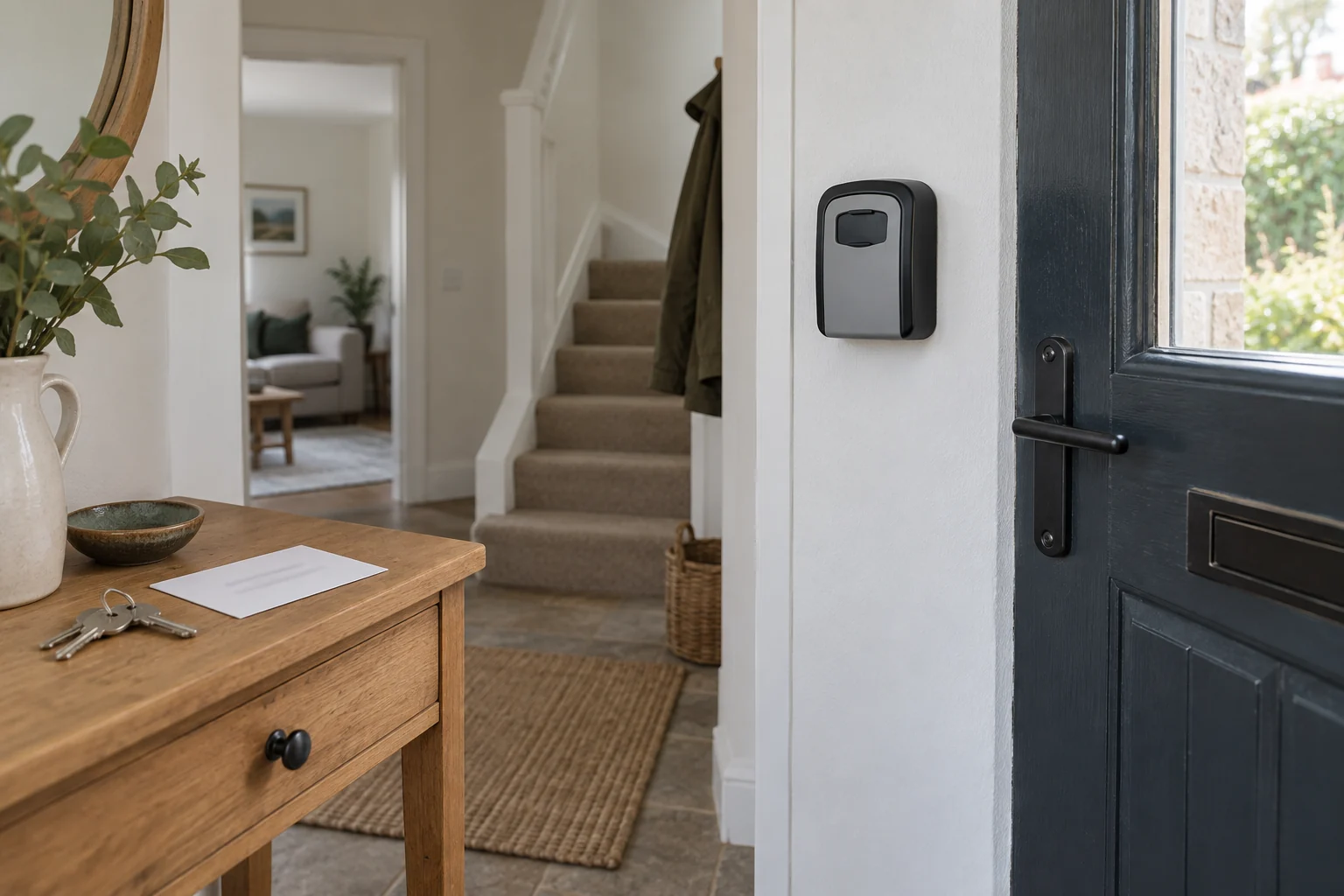
Most holiday let access problems aren't caused by bad instructions. They happen because the right detail reaches the guest at the wrong time: a door code sent a fortnight early is buried by arrival day. What follows is a five-message check-in sequence: what goes in each message, and the fallback that gets a guest inside when a lock or code fails.
Why late-night access problems happen
Every holiday let host knows this message. "Hi, we're outside the property and can't find the code, is there someone we can call?" It arrives late, often once the guest is already tired, standing in the dark, phone signal patchy, bags at their feet.
Most hosts respond to this by rewriting their instructions to be clearer. Longer arrows, better photos, a bigger font on the box. It rarely helps as much as expected, because the problem was never about clarity. It was about timing.
Why one long instruction message isn't enough
The typical setup is a single, detailed message sent shortly before check-in, containing the door code, the lock brand, a link to a video, parking notes, wifi details and house rules all at once. It's thorough. It's also arriving at the exact moment the guest is least able to absorb it.
Think about where most guests are when that message lands. Driving. On a train with patchy signal. Herding kids through an airport. Even if they open it, they skim it, and the one detail that matters, say, the code needs the hash key pressed after it, gets lost among ten other details that don't matter yet. Details that only matter once guests are inside, such as the Wi-Fi, heating and house rules, belong in the welcome guide, and the holiday let guest information checker shows what that guide should cover.
By the time they're standing at the door, they're trying to recall a message they half-read hours earlier, on a phone that's now at 8% battery, in the rain.
Access problems are usually about timing
It's tempting to conclude that guests just don't read messages properly. Some don't. But the more useful frame is that the information was correct and the delivery was wrong. A guest cannot absorb information they weren't in a position to absorb at the time it arrived, no matter how well it's written.
The fix isn't a better single message. It's accepting that no single moment is reliably the right moment for every guest, so the same core information needs to reach them more than once, at points where they're able to take it in, with the detail getting sharper as arrival gets closer.
The five messages in a check-in sequence
Rather than one message doing everything, split the job across a short sequence, each one doing less, at a point where the guest is more likely to be paying attention.
Five natural moments exist in almost every booking: the confirmation moment, right after they book, when they're relaxed and reading closely because they're excited about the trip. A few days before arrival, when they've started planning logistics but aren't yet travelling. The morning of arrival, when travel is imminent but they're still somewhere calm, like home or a hotel. The point where they're close to the property, often the highest-stress moment. And a fallback point, for when something still goes wrong despite all of that.
Here's how the job splits across them.
The check-in sequence at a glance
Each message does less, and the access detail gets sharper as arrival gets closer.
| Message | When | What it carries | Leave out |
|---|---|---|---|
| Booking confirmation | Straight after booking | Welcome, check-in time, anything that could change their plans | The door code |
| Full instructions | Two to three days before | Step-by-step access, a photo of the lock, backups, a contact number | House rules they don't need yet |
| Morning of arrival | The morning they travel | Check-in time, a one-line access reminder, anything time-sensitive | The full instructions again |
| Near arrival | An hour or two before check-in | The code and steps in full, and what to do if it fails | Anything else |
| Fallback | In every access message | One line: who to call if it doesn't work | Nothing; this line always goes in |
What goes in the booking confirmation message
This first message isn't about access at all. It's about setting expectations early, while the guest has time and attention to spare. Keep it short: a warm welcome, roughly what time check-in opens, and a line letting them know full arrival instructions will follow closer to the date. This is also the right moment to flag anything that could change their plans, like a gravel driveway unsuitable for low cars, or limited parking that needs booking ahead.
Avoid the temptation to dump the door code here. It's too early, it'll be forgotten, and if there's any chance the code changes between guests, you'll end up correcting yourself later.
What goes in the message a few days out
Around two to three days before arrival is when people start planning the journey. This is where the full instructions belong: the exact access method, step by step, with a photo of the lock or key box if there is one, plus what to do if it doesn't work first time. Anything guests need once they're inside, such as the heating, the Wi-Fi and the bins, belongs in the holiday let welcome guide rather than in this message.
Include alternates here too. If there's a keypad and a backup physical key, say so. If the wifi is needed to load a smart lock app, mention that the app works offline too if it does, or that there's a physical backup if it doesn't.
This message also carries a phone number to contact if something's unclear, framed as low-pressure: "and if anything's confusing, just message, happy to talk it through before you set off."
The arrival-day message
On the morning of arrival, send a short, upbeat reminder. This one exists less to repeat detail and more to catch anything that's changed: a delayed flight, traffic, a plan to arrive earlier or later than booked. It's also your chance to flag anything time-sensitive, like a bin collection blocking the driveway that morning, or a delivery due.
Keep this one brief. One or two sentences plus a repeat of the key facts: check-in time, and a one-line reminder of how access works, without the full detail again. Guests skim this one for changes, not instructions.
The message just before arrival
The most important message in the whole sequence goes out close to actual arrival, either time-triggered an hour or two before check-in, or manually once you know they're travelling. This message repeats the access code and the exact steps again, in full, even though you've already sent them. Redundancy here isn't wasted effort, it's the whole point. This is the message a guest is most likely to be looking at while standing at the door, because it's the freshest one in their inbox.
Word it so it can be read in ten seconds under stress: the code first, the steps in short numbered lines, and a single line at the bottom for what to do if it doesn't work.
Here's what that looks like.
An example near-arrival message
Readable in ten seconds, standing at the door.
Building in a way out when something still goes wrong
Even a well-built sequence won't catch everything. Locks fail, apps crash, a guest's phone dies. What separates a minor hiccup from an 11pm crisis is whether there's a clear, obvious next step built into the message itself, rather than the guest having to guess who to contact or dig back through old messages.
That means every access message, not just the last one, should carry a single line: "if this doesn't work, call [number] and we'll sort it straight away." Not buried in a paragraph. On its own line, easy to spot on a small screen in the dark.
If there's an offline backup, like a lockbox with a physical key as a fallback to a smart lock, mention its existence early so the guest knows it's there even if they never need it.
Sending door codes safely
Access details are the most sensitive thing you send, so a few habits matter. Change the code between bookings where your lock allows it; many smart locks can create a code for each stay that stops working at checkout. Never put a code in your listing or anywhere public, and send it through the booking platform's messaging or directly to the guest, not in a group chat or a message a third party might see.
If your key safe uses a fixed code, change it regularly and after any stay where you're unsure it was kept private. The near-arrival message is the one to rely on for the code, so if it does change, that message will always have the current one.
Late-night arrivals
A guest arriving after dark faces everything above with less light and less patience. Check the key safe or keypad can be seen and read at night: a porch light on a timer or sensor makes more difference than any wording. A photo of the entrance in your full instructions helps guests recognise the right door when they've never seen it.
If a guest tells you they'll arrive late, send the near-arrival message when they're close rather than at the usual time, and make sure the fallback number will be answered. A late arrival is exactly when a lock problem feels worst.
How many messages is too many
There's a real limit here, and it's worth naming directly. Guests don't want ten separate check-in messages. If every message reads as a fresh demand for attention, the sequence starts working against itself and important messages get skimmed along with the trivial ones.
The way to avoid this is to make each message obviously different in purpose and length. The confirmation message is a welcome. The few-days-out message is the instruction manual. The morning message is a thirty-second check-in. The near-arrival message is short and functional. If a guest can tell at a glance which message is which without opening it, the volume stops feeling like noise.
What to do when the lock itself fails
No message sequence fixes a broken lock, a dead keypad battery, or a code that's stopped working because of a system glitch. What the sequence buys you is time and calm, because the guest already has a phone number in hand and already expects that hiccups get sorted quickly, rather than feeling abandoned.
Practically, this means checking smart lock batteries and code accuracy ahead of every changeover, not waiting for a guest to report failure. It also means having a reachable person, or at minimum a very clear voicemail and fast callback promise, during arrival windows. A message sequence that ends in silence when something breaks undoes all the good work the earlier messages did. Put those checks on your changeover list; building a changeover checklist from scratch shows how.
If a guest still gets stuck, what to do when a guest reports a fault mid stay covers the next steps.
Test the sequence as a guest would
Once your messages are set up, send the whole sequence to yourself as if you'd booked. Read each one on your phone, not a laptop, at the point it would arrive.
Then do the hard version: stand at the door at dusk with only the near-arrival message open, and follow it exactly as written. If you have to scroll, guess or remember anything from an earlier message, the guest will too. Fix it until the last message alone gets you inside.
Setting up your check-in sequence
If you take nothing else from this, take the redundancy: the key details, repeated at each point the guest might need them.
Before your next booking, schedule each message through your booking platform or set calendar reminders, then stand at the door and test the near-arrival message on your phone. Splitting one long message into a staged sequence costs nothing extra to write, and the guest arriving at 11pm with 8% battery will find what they need in the latest message, the one you control. Automating holiday let guest messages without losing the personal touch covers which messages to schedule, and writing guest message templates that sound like you helps each one read like you.